


Willamette Valley
Crisis Care
Community Responders based in Eugene, OR
In these difficult times, we are skilling up our capacity to care for each other with tools for crisis intervention, boundaries, and scene safety. Join us in envisioning and practicing safety and resilience. A special welcome to vets on Veterans Day as well as Bethel area friends and neighbors!
Presented by WVCC with co-host, Active Bethel Community Neighborhood Association. Capacity is available to the first 99 attendees.
The event will take place at Shasta Middle School on November 11, from 6-8pm.
Read about our first of six Community Safety and Care Townhall and Skill-up series in the news.
Are you interested in bringing a de-escalation and crisis prevention training at your workplace?
Contact us to discuss bringing a customized training to your organization.A special THANK YOU to the Chambers Family Foundation for their support of this initiative.
.jpg)
What was the impact of losing CAHOOTS?

A Gap in Eugene’s Crisis Care: Navigating welfare checks without CAHOOTS
After CAHOOTS: Service decline, shifting police attention, and a rising arrest rate
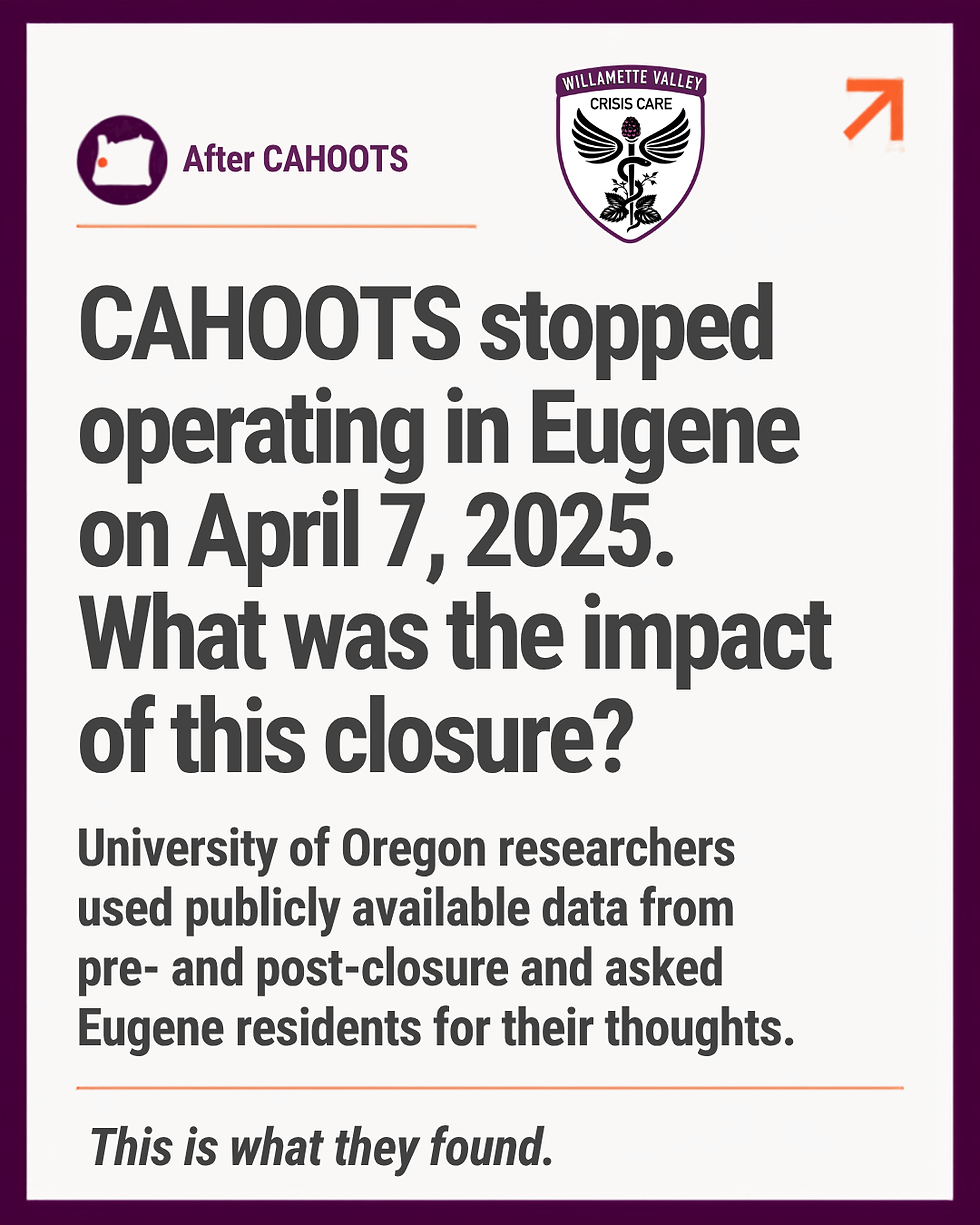
CAHOOTS stopped operations in Eugene on April 7th, 2025. What was the impact of this loss? Our research partners at the University of Oregon, Rori Rohlfs, Claire Herbert and their teams, analyzed publicly available call data and interviewed Eugene residents to publish two powerful reports on the impact of the loss of community responder welfare check service. Watch the video and follow the links to learn more.

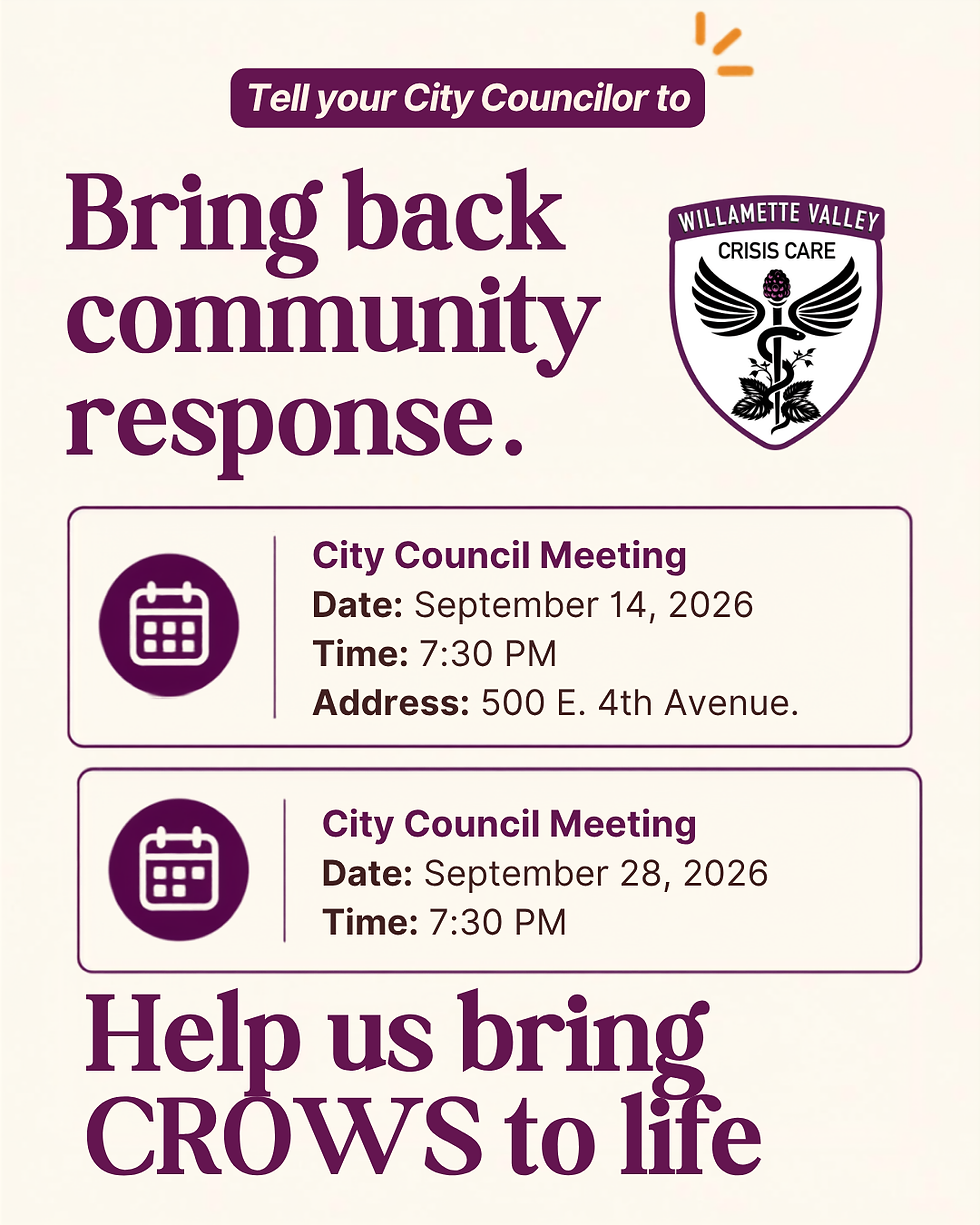
WVCC Explores Community-Funded Community Responders Offering Wellness and Safety (CROWS)
Following the City of Eugene’s decision to bypass local, comprehensive care in favor of a private, for-profit corporation, Willamette Valley Crisis Care (WVCC) will host listening sessions to explore alternative response pilot to divert calls from the overburdened 911 system.
A Missed Opportunity for Eugene
The city is spending $500,000 on a referral-based peer navigation outreach program that doesn’t offer critical services like alternative response. For that same price, WVCC offered a comprehensive, locally rooted community response model: Community Responders Offering Wellness and Safety (CROWS) plus Aftercare. WVCC’s model was meticulously designed to safely divert and absorb the 28% surge in welfare checks currently straining the Eugene Police Department since the suspension of White Bird Clinic’s CAHOOTS services in Eugene. EPD reported a 36% increase in arrests in 2025, including a 58% increase in criminal trespass arrests.
CROWS plus aftercare would have offered 10 hours a day 7 days a week of community response services–including welfare checks–and 8 hours a week of aftercare.
National Recognition: WVCC Tapped for Just Safe’s Scaling Safety Initiative
WVCC has been awarded a major contract to provide training and technical assistance to Just Safe’s Scaling Safety Initiative, which works in five cities–Tucson, Cleveland, Miami, Jackson, and Austin. WVCC will support leaders in community-based public safety to increase the capacity of consent-based, unarmed civilian response.
WVCC continues to be a leader nationally in alternative response. A WVCC founder presented at the National Co-Responder Alliance Conference with the Center for Health and Justice in Dallas earlier this month. Founders are co-facilitating the Alternative Mobile Services Association's state collective for Oregon with explicit legislative goals to recapture funds dedicated to community care over enforcement.
What's Next for WVCC?
Thanks to generous donors, every dollar raised during this campaign will be matched dollar-for-dollar, directly funding WVCC’s efforts to create sustainable funding for CROWS and integrated community-based crisis response services. Additionally, this matching campaign supports local trainings, and state and national advocacy for care non-carceral solutions: alternative community-based response.
About Willamette Valley Crisis Care (WVCC)
Willamette Valley Crisis Care is dedicated to creating community-led, wellness-centered alternatives to public safety and crisis response. Through training, consulting, and strategic partnerships, WVCC works to ensure that safety means care, dignity, and accountability for every community member.
We believe that a city known nationally for its approach to alternative response can again be a leader in community based public safety.


